

Hmmm… an interesting question indeed!
It’s hard to disagree this type of business model elicits a spectrum of reactions from pure adoration to outright vilification.
The one where those involved often don their stealth gear, armed with a list of everyone they’ve ever known, preparing to recruit them into their downline without revealing the product they’re peddling until the right moment.
It’s like a rollercoaster of emotions.
For most, network marketing is a subject that can instantly provoke a response. Some people’s curiosity is piqued, while others are left with a dash of suspicion and some… well…








For many network marketers it often feels like the prospect of someone genuinely wanting to know more about what they have to offer feels like discovering a rare gem.
Yet, every day, people venture into the world of NWM, hoping to improve their lives and find some level of success.
Some find it, while many others don’t.
Some would argue that aiming for prosperity in any venture whether it be network marketing, launching our own business, or pursuing a traditional career that hard work, commitment, discipline, and unshakeable belief (plus a little luck going our way) are all vital ingredients to help achieve a successful outcome.
So why would it be any different for a network marketing venture?
Well, it’s hard to disagree with that.
But I do have one question…
Why does this multi-billion dollar industry with a not-so-stellar reputation leave so many disheartened, and provoke a slew of vocal critics often drawing both skepticism and outright hostility?
Is the high failure rate really due to a lack of hard work, commitment, discipline and unshakeable belief from so many?
Or could it be something else?
Perhaps a broken model, very average products/services with offensively over-inflated prices, deceptive marketing practices, absurd promotional restrictions making it virtually impossible to attract legitimate customers (or perhaps a combination of everything), where the odds of succeeding are still grossly unfavourable to those who do apply themselves and actually do the work?
I’m not saying one size fits all here, but there’s certainly no shortage of horrendous horror stories out there to substantiate the bitterness felt by so many.

But is there more to the story?
The truth is, network marketing, like anything else in life, is a mixed bag. For every proponent who hails it as the road to riches, there’s a detractor who condemns it as a bottomless pit of despair.
Whether it’s hailed as a treasure or trashed as trash depends on who you ask.
And in this vast expanse of online opinions, reviews, forums, and testimonials, it can be a real jungle out there. Many voices have their own agenda, whether it’s maligning one thing to promote another or inflating their ego to gain credibility in a different realm.
Thus, it’s essential to approach everything you encounter with a healthy dose of skepticism.
Perspectives are like fingerprints, unique to the individual and diverse as the colours in a rainbow. They’re informed by personal experiences, research, and belief systems. Not everyone will see eye to eye on the subject, and that’s perfectly acceptable.
It’s not about who’s right or wrong; it’s about sharing personal viewpoints based on unique experiences.

And that’s perfectly okay.
Personal experiences can also be wildly different. Someone who’s thriving in network marketing will naturally sing its praises, defending the industry, the company they represent, and the business model. After all, if they’re making a handsome income, it’s human nature to be a cheerleader for the cause.
On the flip side, if someone had a disastrous encounter with a network marketing venture, they might harbour a less-than-rosy view.

Yet, when I delved into the world of network marketing, I found myself pondering some nagging questions:
- Why does it have such a dubious reputation that most involved feel compelled to keep it under wraps and use cryptic language when speaking with prospective customers?
- Why has it been a magnet for questionable and unethical behaviour for decades?
- Why do some companies implementing this model insist their distributors purchase inventory for in-person sales when we live in a world with a thriving online economy, where almost anything can be sourced and delivered within days?
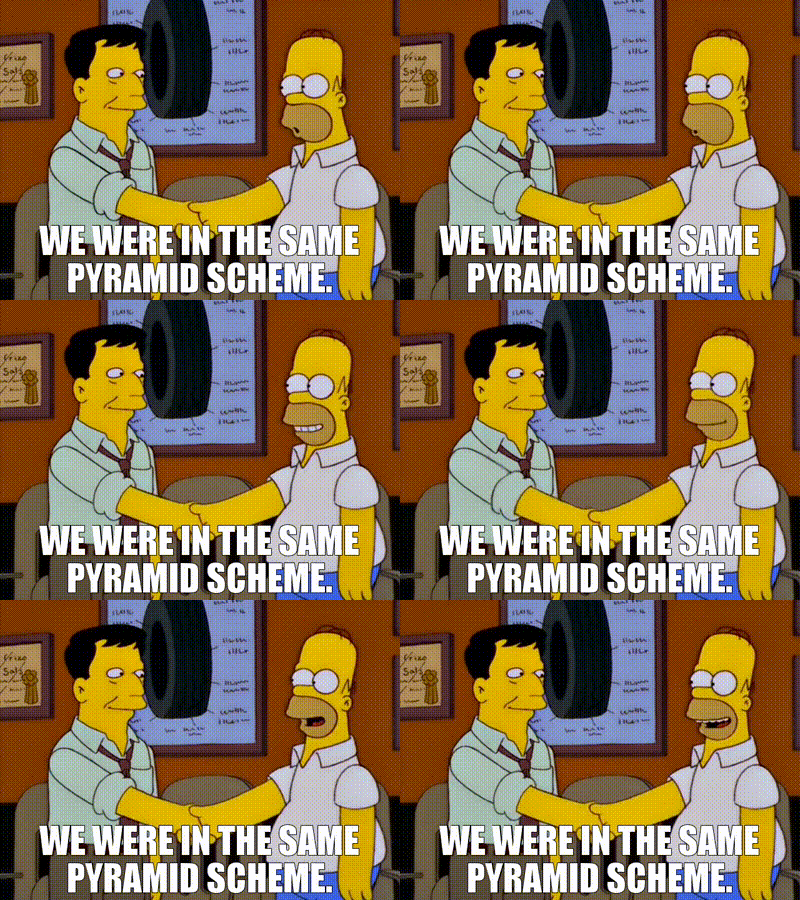
- Why is it highly improbable for a distributor to earn a liveable income from retailing products, pushing them to recruit more distributors who essentially become customers in their downline – almost like a legal yet unsustainable pyramid scheme where the numbers simply don’t add up?
- Why is there an infinite number of distributors allowed in a single area, leading to market saturation for both the product/service and business opportunity?
These are fair and reasonable questions and you could say the results from my own research and thought provoking realisations were eye-opening to say the least and this is where it gets really interesting…